For ecommerce advertisers, Performance Max versus Shopping is not a simple choice between an old campaign type and a newer one. It is a decision about control, data quality and margin. Get it wrong and Google may spend efficiently towards low-value sales, branded demand you would have captured anyway, or products that cannot support profitable acquisition.
Performance Max can create impressive reach and scale. Standard Shopping can provide cleaner control over products, bids and search intent. The better option depends on your catalogue, conversion tracking, creative assets, brand strength and, above all, the commercial KPI that matters to your business.
What changes in Performance Max versus Shopping?
Standard Shopping campaigns primarily serve product ads across Google Shopping results, Search and partner placements. The advertiser retains meaningful levers: product groups, campaign priorities, negative keywords in some account structures, bidding approaches and budget allocation by product category, brand or margin band.
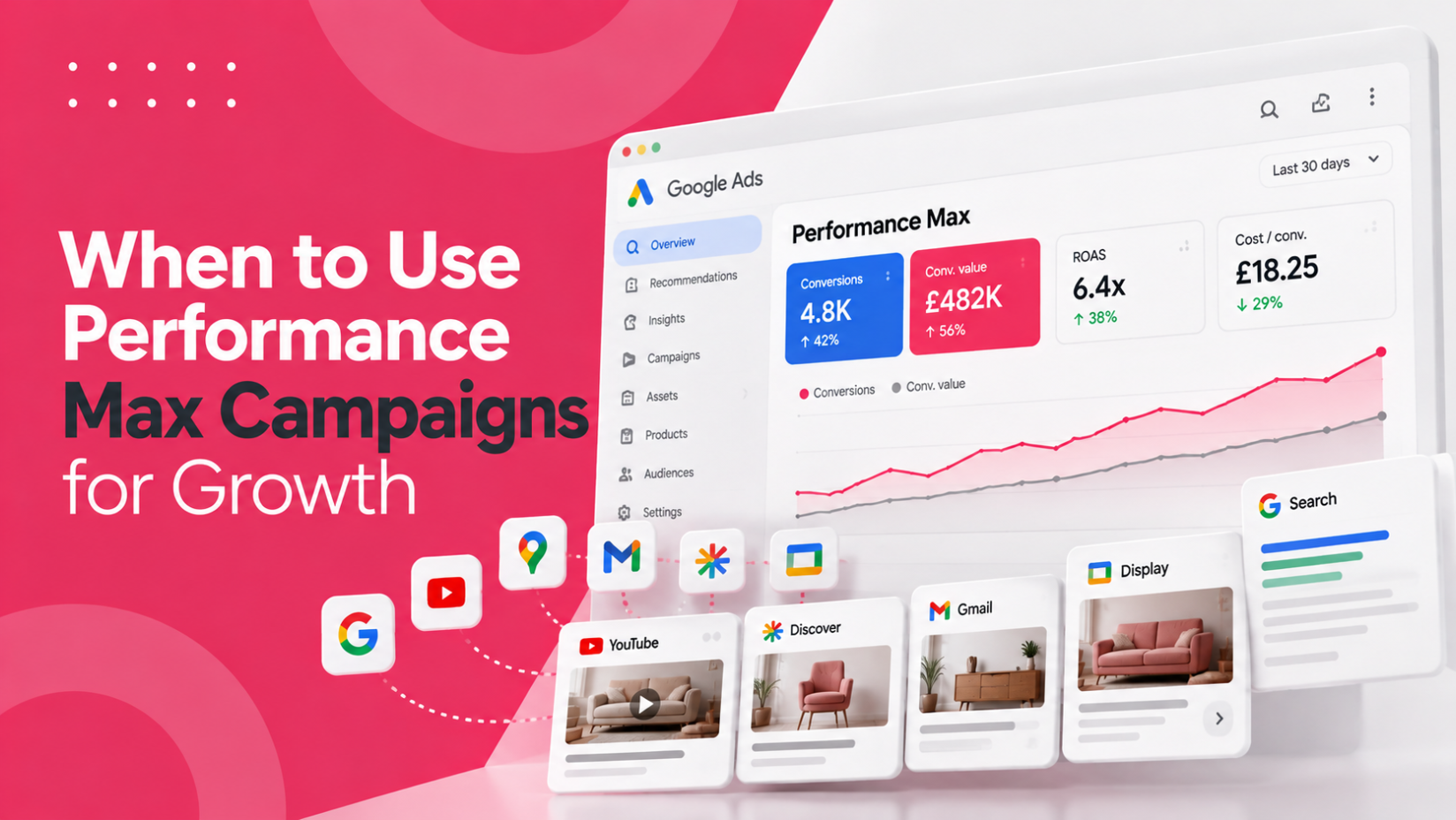
Performance Max uses the same Merchant Centre product feed but distributes ads across Google’s wider inventory, including Shopping, Search, YouTube, Display, Discover, Gmail and Maps. Google’s machine learning determines where to show the ad and to whom, using the conversion goals, audience signals, feed data and creative assets supplied.
That wider reach is PMax’s opportunity and its risk. It can find purchasers beyond obvious product searches, but it also gives the advertiser less visibility into where spend has gone and why one product or audience has been favoured over another.
The practical difference: control versus automation
With Standard Shopping, an experienced manager can isolate high-margin categories, seasonal products or bestsellers, then assign budgets around their real commercial value. If a product line is out of stock, has a weak conversion rate or has become uncompetitive on price, action can be direct and contained.
Performance Max makes many of those decisions at campaign level through automation. You can use listing groups, exclusions, asset groups and campaign-level targets, but you cannot control every placement, search query or bid in the same way. That does not make PMax poor. It means the account needs better inputs and more disciplined measurement before automation is allowed to scale.
When Performance Max earns its budget
Performance Max is often effective for retailers with a healthy product feed, reliable purchase-value tracking and enough conversion volume for Google’s systems to learn. It is particularly useful when a business wants to expand beyond bottom-funnel Shopping demand without creating and managing separate campaigns for every Google channel.
It is a stronger candidate when:
- the account records accurate transaction values, refunds and preferably profit-informed data;
- the product feed has clear titles, GTINs, high-quality imagery, pricing and availability;
- there are enough products and sales to give the algorithm meaningful signals;
- the brand has video, imagery and copy that represent the offer well;
- the target is profitable revenue growth rather than maximum control over each search term.
PMax can also be valuable for remarketing and for products with broad visual appeal. A homeware, fashion, beauty or gifting retailer may find that compelling assets generate demand before a person searches for a specific item. Standard Shopping alone is less able to support that full-funnel role.
However, a high ROAS reported by PMax should be interrogated, not simply celebrated. Branded searches, existing customers and remarketing audiences can make performance look stronger than the incremental revenue actually created. Review brand search trends, new versus returning customer data and total account revenue alongside campaign-level ROAS.
PMax needs more than a feed
A common mistake is treating Performance Max as automated Shopping: upload a feed, select a target ROAS and leave it alone. The platform then has limited context on which customers are most valuable, which products are profitable and what a meaningful conversion looks like.
Feed optimisation still matters. Product titles should reflect how people search, descriptions should be accurate, images should sell the product without breaching Merchant Centre rules, and custom labels should identify margin, price bands, seasonality or stock priority. Asset groups should have a clear purpose, rather than becoming a collection of generic creative.
Most importantly, use the right conversion signals. If Google is optimising towards every low-value action on a website, it will find more of them. For many ecommerce brands, purchase value should be the primary signal, with secondary actions observed separately. Where possible, enhanced conversions, consent-aware tracking and offline or profit data can improve decision-making.
When Standard Shopping is the better commercial choice
Standard Shopping remains highly useful where profit depends on precise product-level management. A retailer selling thousands of SKUs with sharply different margins may not want an algorithm pushing the products that merely convert most easily. The business may need to protect budget for products with stock to clear, strong lifetime value or a better contribution margin.
It is also often preferable for smaller accounts with limited sales history. Automation needs sufficient, accurate data. If an account produces only a modest number of monthly orders, a tightly structured Standard Shopping campaign can offer clearer learning and reduce the chance of unpredictable budget allocation.
Standard Shopping gives ecommerce teams a more transparent way to answer commercially important questions: Which categories are driving revenue? Are competitors taking share on a specific product range? Is a price increase affecting conversion rate? Are generic product searches profitable, or is spend being carried by the brand?
This visibility is especially valuable when a business is fixing fundamentals such as feed quality, checkout performance or conversion tracking. It is difficult to diagnose a weak landing page or an uncompetitive offer if several Google channels are combined into one campaign’s results.
Control does not automatically mean better performance
Standard Shopping requires active management. Poor campaign structure, broad product groupings and infrequent search-term analysis can waste as much budget as an over-automated PMax campaign. Control only becomes an advantage when someone uses it to make informed decisions.
For a straightforward catalogue with solid data and limited internal resource, PMax may deliver more scale with less day-to-day intervention. Conversely, an expert-managed Shopping structure can outperform broad automation when the account has a complex catalogue, strict margin rules or a requirement to separate brand and non-brand demand.
A sensible way to test both campaign types
The most reliable answer is often not choosing one forever. It is building a controlled testing plan that protects revenue while creating evidence.
Start by defining the business outcome. ROAS is useful, but it is not always enough. A £10,000 revenue campaign at 500% ROAS may be less valuable than one at 350% if the second drives more contribution profit, new customers or repeat purchase potential. Set targets around net margin where the data allows it.
Then separate product sets or use Google’s available experimentation tools to avoid both campaign types competing for the exact same inventory without a clear test design. Compare performance over a meaningful period, allowing for seasonality, promotions and stock changes. Do not declare a winner after a few days of volatile results.
Assess the results using more than platform reporting. Look at total paid revenue, blended ROAS, new-customer contribution, branded search behaviour, conversion rate and profitability by product group. If PMax reports exceptional results while total sales remain flat, it may be harvesting existing demand rather than producing incremental growth.
Finally, give the campaigns the right operational support. Shopping needs ongoing feed work and commercial segmentation. PMax needs regular asset refreshes, audience signal review, placement scrutiny where reporting permits, brand safeguards and conversion-goal governance. Neither campaign type is genuinely set-and-forget.
The decision for UK ecommerce businesses
Choose Standard Shopping when your priority is product-level transparency, budget control and careful management of a complex or lower-volume catalogue. Choose Performance Max when your data is trustworthy, your creative is credible and you need Google to find additional demand across multiple channels.
For many established retailers, the strongest approach is a considered mix. Standard Shopping can retain control over priority product lines, while PMax is tested against defined product groups or used to expand reach where the incremental opportunity is proven. The budget split should follow profit and evidence, not Google’s latest campaign recommendation.
Maple Forest Marketing approaches this decision through the numbers that matter: clean tracking, product profitability, customer acquisition and sustainable ROAS. A free PPC audit can reveal whether your account needs more automation, tighter control, or simply a clearer measurement framework before further budget is committed.
The useful question is not whether Performance Max or Shopping is superior in isolation. It is whether each pound is creating sales your business can profitably keep.