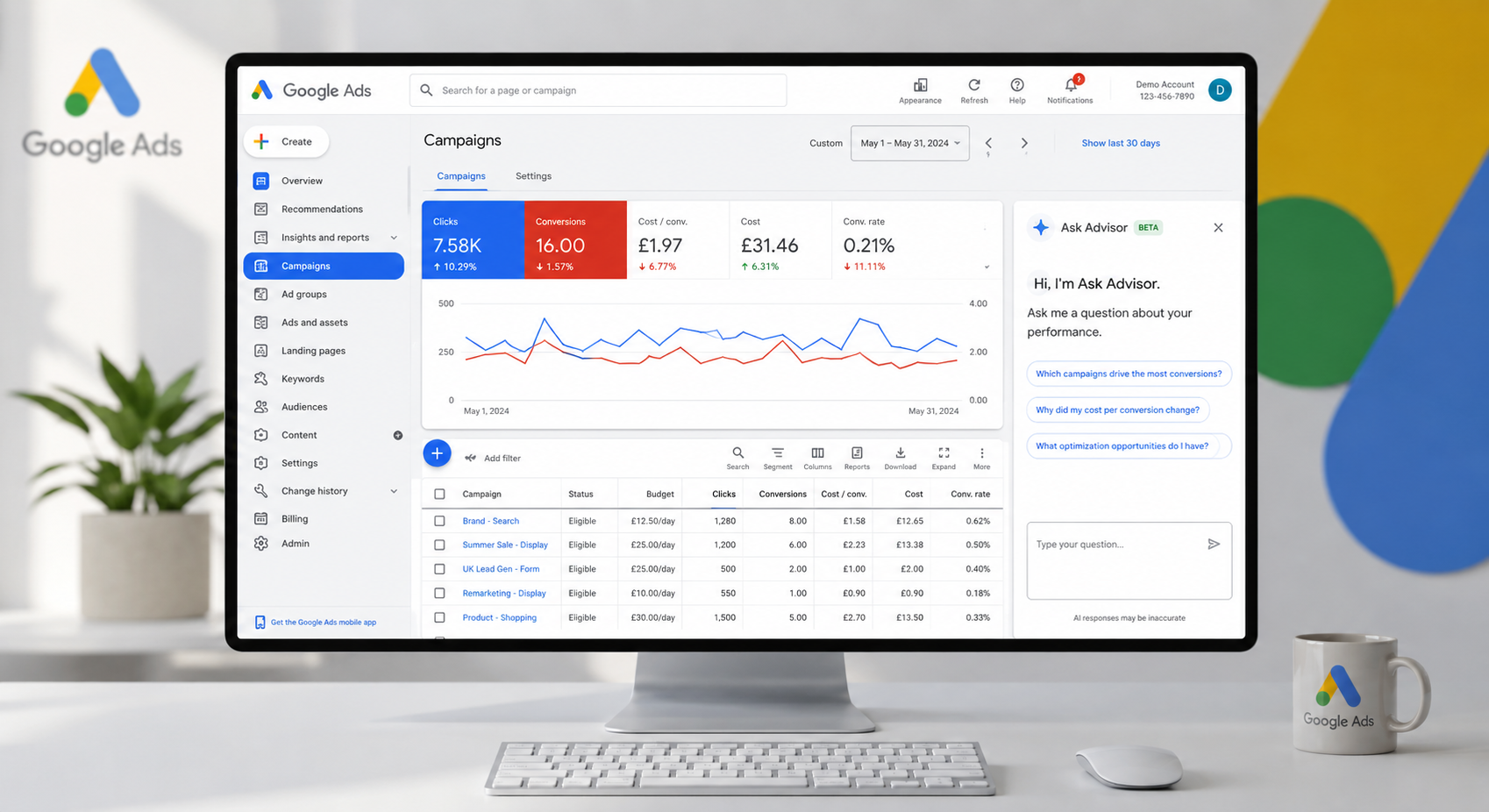
A click is not a result. It is a cost with potential. When Google Ads, Meta or LinkedIn campaigns send the right people to a website but those visitors fail to enquire, buy or book, the usual response is to adjust bids, audiences or creative. Often, the bigger opportunity sits after the click. Conversion optimisation is the discipline of removing the friction that stops paid traffic becoming profitable revenue.
For UK businesses managing rising media costs, this work has a direct commercial impact. A stronger conversion rate can lower cost per acquisition without cutting visibility, improve return on ad spend and make an existing budget go further. But it only works when decisions are based on evidence, not a collection of generic website “best practices”.
What conversion optimisation really means
Conversion optimisation, sometimes called conversion rate optimisation or CRO, is a structured process for increasing the percentage of visitors who complete a valuable action. That action depends on the business model. For an ecommerce brand, it may be an online purchase with a healthy margin. For a B2B firm, it may be a qualified consultation request rather than a low-intent brochure download. For a local service business, a phone call or completed booking form may be the priority.
The distinction matters because not all conversions are equal. A campaign can appear successful if it generates cheap form fills, while the sales team receives enquiries from people outside its service area, with no budget or no genuine buying intent. Optimising towards volume alone can make reporting look healthier while profitability falls.
A useful conversion strategy therefore connects the complete journey: ad message, keyword or audience, landing page, form completion, sales qualification and eventual revenue. The target is not simply a higher percentage in analytics. It is more valuable customers at an acquisition cost the business can sustain.
Start with measurement before changing the page
A surprising number of landing-page changes fail because the data underneath them is incomplete. If tracking counts every button click as a lead, or if purchases are duplicated, optimisation becomes guesswork dressed up as analysis.
First, define the primary conversion for each campaign. Keep it close to commercial value. A purchase, confirmed appointment, qualified telephone lead or completed quote request is normally stronger than time on site or a newsletter sign-up. Secondary actions can still be useful for diagnosing engagement, but they should not lead bidding decisions unless there is a proven link to revenue.
For lead generation, feed quality back into the advertising platforms wherever possible. Tag leads in the CRM by outcome: unqualified, qualified, opportunity, won. This shows which campaigns, search terms and audiences are driving business rather than merely filling a spreadsheet. Ecommerce operators should similarly look beyond platform-reported revenue to cancellation rates, repeat purchase behaviour, gross margin and contribution after advertising costs.
There is a trade-off. More granular tracking takes time to configure and depends on consent, CRM processes and clean data. Yet without it, automated bidding tools are likely to pursue the easiest signal available, which is not always the most profitable one.
Check where visitors leave
Once measurement is credible, identify the point at which intent drops away. Analytics can reveal whether paid visitors leave immediately, browse product pages but abandon baskets, start a form but do not submit it, or convert but later prove poor quality.
Heatmaps and session recordings can add context, particularly on mobile. They may show that a key call to action sits below a large image, a delivery detail is hard to find, or a form field causes unnecessary hesitation. Treat these tools as clues, not verdicts. A handful of recordings cannot tell you what the full audience wants.
Match the landing page to the reason they clicked
The most effective landing pages continue the conversation started in the advert. If a Google Ads user searches for “commercial office fit out London”, lands on a generic home page and has to hunt for relevant services, proof and next steps, valuable intent is being wasted.
Message match means the headline, offer and page content reflect the search term or advert promise. It does not mean repeating keywords unnaturally. It means answering the visitor’s immediate question quickly: am I in the right place, does this business understand my need, and what happens if I contact them?
For a specialist service, the page should state who it is for, what problem it solves, the geographical coverage where relevant and a clear route to speak to someone. For ecommerce, the product page should remove avoidable uncertainty around price, stock, delivery, returns, sizing or compatibility before a visitor reaches checkout.
Generic traffic can justify a broader page. High-intent campaigns usually deserve more precise destinations. Creating dedicated pages requires resource, so prioritise the campaigns with meaningful spend, strong intent or an established record of converting. Do not build twenty near-identical pages simply to make an account look sophisticated.
Reduce friction without removing reassurance
Fewer form fields often improve completion rates, but a shorter form is not automatically better. A high-value B2B provider may need a company name, project scope or budget range to help its team respond properly. Removing every qualifier can create a flood of weak leads and increase sales workload.
The right question is whether each field earns its place. Ask only for information needed to begin a useful conversation. Explain why you need anything that feels sensitive. On mobile, use the appropriate keyboard for phone numbers and email addresses, make error messages clear and avoid tiny fields that are awkward to complete.
Trust works in the same way. Prominent reviews, relevant case studies, recognised accreditations, secure payment indicators and transparent contact details can reduce risk, but only when they are genuine and relevant. A wall of unrelated logos or vague claims such as “industry-leading service” rarely persuades a cautious buyer.
For service businesses, showing how quickly an enquiry will be answered is often more useful than another marketing statement. For online shops, a clear delivery and returns policy close to the purchase decision can have more influence than an additional promotional banner.
A conversion optimisation process built for paid media
Optimisation should run as a continuous commercial process, not as a one-off redesign. The strongest test ideas usually come from the gaps between advertising performance and on-site behaviour.
- Find the opportunity. Review performance by campaign, device, location, audience and landing page. Look for expensive traffic with poor conversion rates, strong engagement but low form completion, or high-volume search terms that lead to low-quality enquiries.
- Form a specific hypothesis. For example: visitors from a “same-day delivery” advert may abandon because delivery cut-off information is unclear. The proposed change should address that specific barrier, not several unrelated elements at once.
- Test a meaningful change. Test one clear proposition, layout or step in the journey against the current version. Avoid declaring a winner after a few conversions. Low-volume businesses may need longer test periods or may be better served by careful iterative improvements supported by qualitative evidence.
- Judge the business outcome. Compare lead quality, revenue, CPA, ROAS and margin where available. A test that increases leads by 20% but reduces close rate may not be a success.
Testing discipline prevents teams from changing headlines, forms, imagery and offers all at once, then claiming credit when results move. Paid traffic is affected by seasonality, competitor activity, promotions and search demand. A considered process helps separate a genuine improvement from normal variation.
Common mistakes that waste advertising budget
The first is treating the conversion rate as the only KPI. A low-priced impulse product may convert at a much higher rate than a considered purchase, but neither number is meaningful without revenue and profit context. The second is sending every campaign to the home page. Home pages have a role, but they are rarely tailored to every high-intent query.
Another mistake is copying competitors without understanding their economics. A competitor may offer free delivery, a deep introductory discount or a seven-field quote form because its margin, sales process and audience are different. Borrow ideas, but test them against your own commercial reality.
Finally, do not let platform recommendations set the entire agenda. Google and Meta can identify technical issues and surface useful opportunities at scale, but their systems are designed to increase activity within their platforms. An experienced review should ask whether the proposed change will improve profitable customer acquisition, not simply generate more measurable actions.
Make every paid click work harder
Conversion work is most valuable when it sits alongside disciplined campaign management. Better targeting brings more relevant visitors. Better landing pages give those visitors a compelling reason to act. Better tracking tells the business which combinations create real revenue.
Maple Forest Marketing approaches this as part of accountable PPC management: reviewing the journey from search term or social advert through to lead quality, sales and ROAS. The aim is not to chase a flattering dashboard metric. It is to make each pound of paid media more likely to produce a commercially worthwhile outcome.
Choose one high-spend campaign this month and follow its users beyond the click. Check the promise in the advert, the clarity of the landing page, the effort required to convert and the quality of the resulting leads or orders. That single review often reveals the next practical improvement worth making.