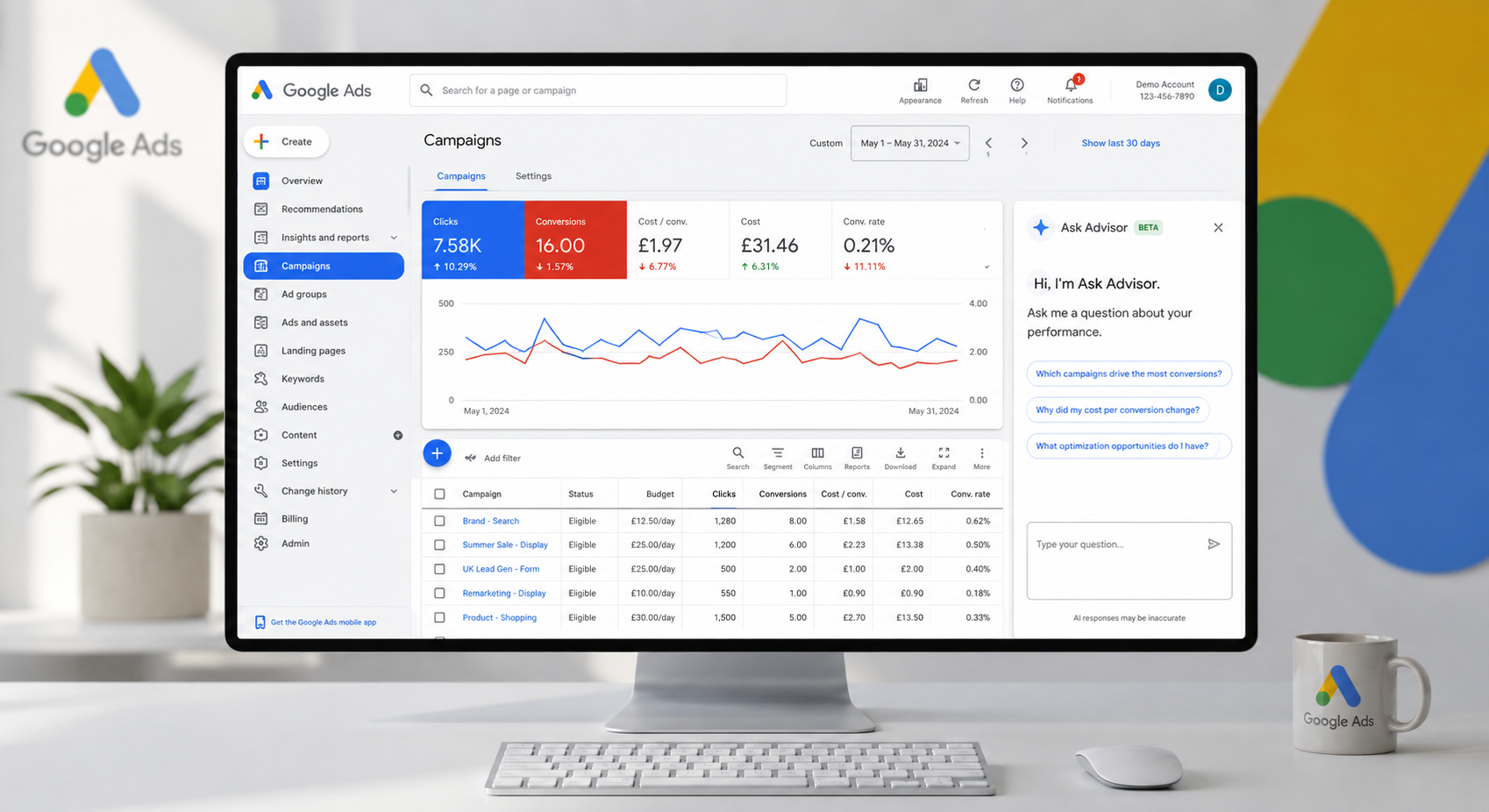
A Google Ads campaign guide should begin with a commercial question, not a platform setting: what is a new lead or sale actually worth to your business? Without that answer, it is easy to celebrate clicks, impression share and automated recommendations while the account quietly spends beyond a profitable CPA or ROAS.
For UK businesses competing in expensive local and ecommerce markets, Google Ads can generate demand quickly. It can also magnify weak targeting, poor tracking and an unconvincing landing page at speed. The difference is a campaign structure built around margin, intent and measurable conversion quality.
Start with the economics, not the budget
A sensible monthly budget follows your targets. If your average qualified lead converts into a £2,000 job and your close rate is 25%, that lead has an expected revenue value of £500. Your allowable cost per lead then depends on gross margin, sales costs, capacity and the profit you need to retain.
Ecommerce calculation is equally important. A £100 order is not worth a £100 acquisition cost simply because revenue appears in Google Ads. Factor in product margin, delivery, returns, VAT and repeat-purchase behaviour. A lower headline ROAS can be commercially acceptable for a high-lifetime-value customer, while a seemingly impressive ROAS can still lose money on low-margin products.
Agree the primary KPI before building anything. For a local service firm, it may be cost per qualified enquiry or booked appointment. For an online retailer, it is often revenue, profit-adjusted ROAS or new-customer revenue. Secondary metrics such as click-through rate and conversion rate help diagnose performance, but they should not become the objective.
Build measurement you can trust
Smart bidding is only as intelligent as the conversion data it receives. If phone calls, duplicate form submissions and low-quality enquiries are all counted as equal wins, Google will find more of them. That may reduce the reported CPA while doing little for the sales team.
Set up conversion tracking for the actions that create value: completed lead forms, tracked calls of an appropriate duration, purchases and, where relevant, quote requests or booked consultations. For ecommerce, pass transaction value accurately and exclude cancelled or refunded orders where your measurement process allows.
The strongest lead-generation accounts go further by feeding qualified lead stages or closed revenue back into Google Ads through offline conversion imports. This takes more coordination between marketing, sales and CRM systems, but it changes optimisation from chasing form fills to finding prospects who become customers.
Check consent settings, tag firing and attribution before launch. A sudden rise in conversions after a tracking change may reflect a reporting issue, not a performance breakthrough. Use Google Analytics alongside Google Ads, but do not expect every platform to report identical numbers. The aim is a consistent decision-making framework, not false precision.
Choose campaign types by intent
Campaign selection should reflect how customers buy. Search campaigns remain a strong starting point when people actively look for a service, product or solution. They give direct control over search terms, messaging, locations and budgets, which makes them particularly useful for local businesses and tightly defined B2B offers.
Shopping and Performance Max can work well for ecommerce, especially where a healthy product feed, competitive pricing and strong creative already exist. Performance Max reaches across Google’s inventory and can scale efficiently, but it offers less granular control than a carefully structured Search campaign. Treat it as a managed growth channel, not a set-and-forget replacement for strategy.
Demand Gen is better suited to creating or capturing consideration among audiences who are not searching at that moment. It can support visual products, promotions and remarketing, but cold audience activity should have clear testing budgets and expectations. It rarely deserves the same immediate CPA target as high-intent Search.
For many accounts, a balanced starting point is Search for core demand, remarketing to re-engage warm visitors, and either Shopping or Performance Max where the product and data justify it. Expansion should follow evidence, rather than launching every available campaign type at once.
Structure Search campaigns around commercial control
A campaign should group products, services or locations with genuinely different economics. A London emergency plumber, for example, should not share budget and bids with lower-value general maintenance work. Nor should a national ecommerce category be mixed with a brand campaign that would likely capture demand anyway.
Within each campaign, organise ad groups around closely related themes. The goal is relevance between the search query, advert and landing page, not an elaborate structure for its own sake. Over-segmentation creates too little data in each area; over-simplification makes it difficult to control spend.
Use a deliberate mix of keyword match types. Exact and phrase match terms usually provide the clearest early control, while broad match can uncover incremental volume when conversion tracking is reliable and smart bidding has sufficient quality data. Broad match is not inherently wasteful, but it requires active search-term review, suitable negatives and a willingness to stop poor themes quickly.
Negative keywords protect budget from irrelevant intent. A commercial solicitor may wish to exclude job searches, free advice and training queries. An ecommerce retailer might exclude searches for repairs, manuals or second-hand products. Review search terms regularly, particularly in the first weeks and after budgets increase.
Location settings deserve the same scrutiny. If you serve London only, use presence-based targeting where appropriate and review where users were actually located. A campaign that appears geographically focused can still attract interest from people merely researching a location.
Write adverts that qualify as well as attract
Good adverts do more than increase clicks. They pre-qualify the right customer by being specific about the offer, geography, price position and proof points. If your service starts at a premium price, vague copy may produce cheap but unsuitable enquiries.
Responsive search adverts need enough meaningful variation for Google to test, but not a collection of interchangeable slogans. Combine the core search intent with a tangible reason to act: accredited specialists, rapid turnaround, product availability, a clear service area or a credible commercial benefit. Use all relevant assets, including sitelinks, callouts, structured snippets, images and call assets, because they improve visibility and give prospects more context before clicking.
The landing page must continue the promise made in the advert. Sending every search term to a generic homepage is a common source of wasted spend. A focused page should answer what is offered, who it is for, why the business is credible and what happens after the enquiry. Keep forms proportionate to the value of the offer, especially on mobile.
Set bidding and budgets with discipline
For a new account or campaign with limited conversion history, there is a case for starting with a controlled bidding approach while you validate keywords, tracking and conversion quality. Once reliable volume exists, automated bidding can use signals no human can assess in real time, including device, audience and query context.
Target CPA and target ROAS bidding work best when the target reflects reality. Set a target too aggressively and volume can collapse. Set it too loosely and Google has permission to spend on marginal traffic. Changes should be measured, not made every few days in response to normal fluctuation.
Budget allocation should follow incremental return, not habit. Protect branded Search if competitors are active, but separate it from non-brand reporting so it does not make acquisition performance look better than it is. Increase spend where conversion quality and marginal returns support it, rather than distributing budget evenly across campaigns.
Optimise with a proper review rhythm
Daily checks are useful for broken tracking, sudden overspend, disapproved adverts and stock issues. They are not enough for strategic optimisation. Most meaningful decisions need a longer view, particularly in B2B sectors with delayed sales cycles or ecommerce categories affected by promotions and seasonality.
Review performance weekly against spend, conversions, CPA or ROAS, search terms, impression share and landing-page behaviour. Then assess monthly performance against qualified leads, sales, revenue and margin. Ask whether the campaign is producing the right type of customer, not simply whether the dashboard is green.
Test one meaningful variable at a time where possible: an offer, landing page, keyword theme, audience signal or bidding target. Changing all of them together can create activity without learning. Keep a record of major changes and their commercial rationale, especially when automated campaigns are involved.
When expert management earns its keep
Google’s automation can save time and find opportunities, but it cannot know your profit margins, sales capacity, regional priorities or the difference between a good lead and a time-waster unless the account is configured to show it. Experienced management is the work of translating those business realities into campaign decisions.
If spend is rising without corresponding qualified leads or profitable sales, a focused audit often reveals the cause: weak conversion definitions, poor search-term control, product-feed issues, misaligned bids or a landing page that loses the customer after the click. Maple Forest Marketing approaches that work with the same standard that matters to owners and marketing managers: every pound should have a defensible route towards accountable growth.
The most productive next step is to review one campaign through the lens of profit, not platform metrics. Identify the conversion that genuinely matters, trace the search terms and landing-page journey behind it, then decide what deserves more investment and what should stop spending. That discipline is where stronger leads, sales and ROAS begin.