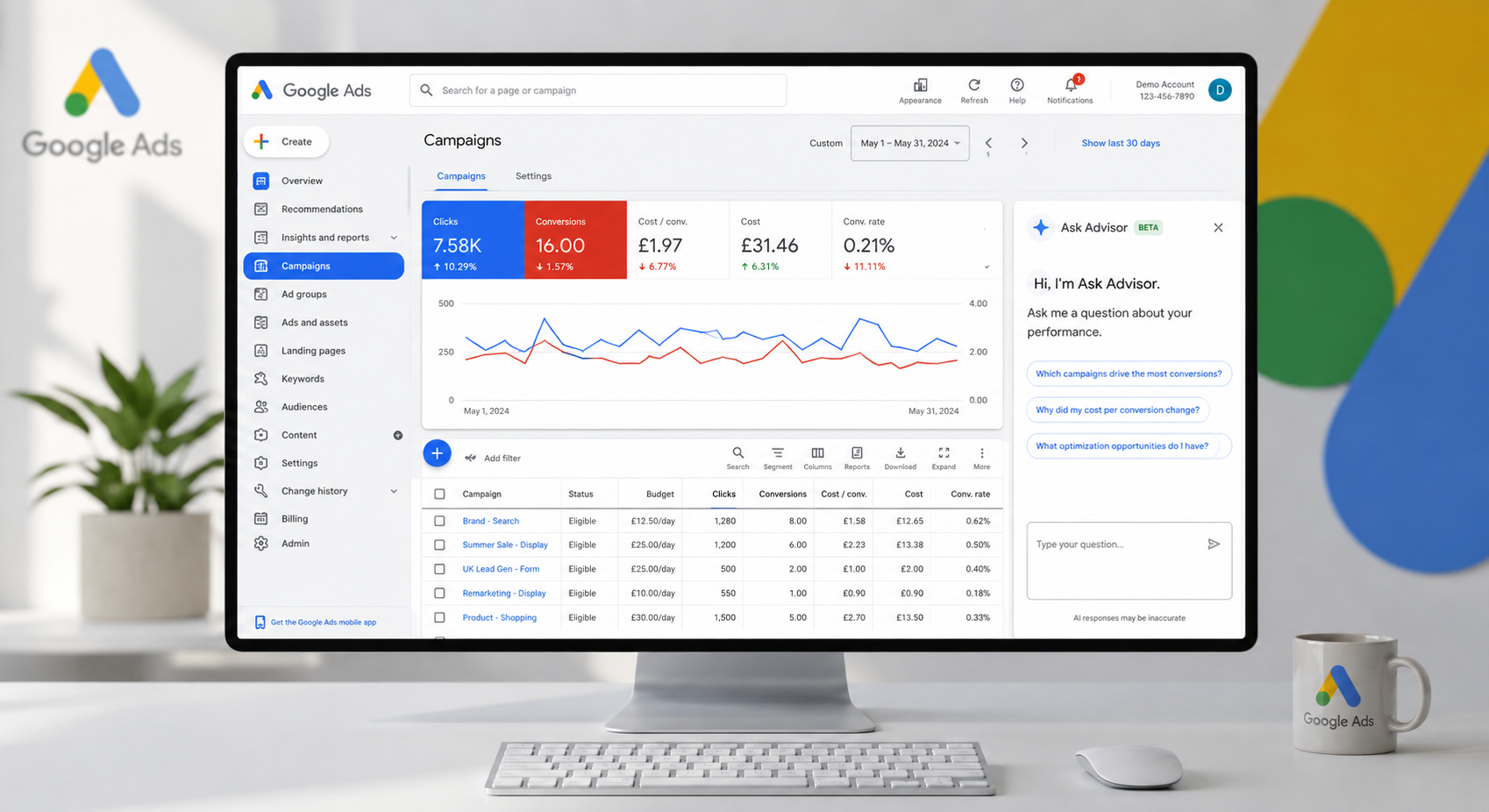
A Google Ads account can report plenty of traffic while quietly draining budget on people who were never likely to enquire, buy or become profitable customers. The question is not simply how to reduce wasted clicks, but how to remove poor-quality traffic without cutting off genuine demand. That requires disciplined decisions around targeting, search terms, measurement and the journey after the click.
For UK businesses, wasted spend is rarely caused by one obvious setting. It is more often the compound effect of broad keywords, weak conversion tracking, default campaign settings and landing pages that do not match the promise of the advert. Fixing those issues can lower CPA, improve ROAS and give the platform clearer evidence of what a valuable customer looks like.
Start by defining what a valuable click means
A click is not wasted merely because it does not convert immediately. A prospective customer may research on mobile, return later through a branded search and then complete an enquiry or purchase. The real concern is traffic that has little commercial relevance from the outset, or traffic that repeatedly fails to contribute to revenue.
Before changing bids or pausing keywords, agree on the conversions that matter. For an ecommerce business, that is usually profitable sales, revenue and margin rather than just checkout starts. For a lead-generation business, it may be qualified enquiries, booked consultations, phone calls of a meaningful duration or sales that reach a defined stage in the CRM.
This distinction is vital. If Google Ads is optimising towards every form submission, including spam, job applications and low-value requests, it will find more of them. Importing qualified lead or offline sales data gives automated bidding a much stronger foundation. It also prevents apparently cheap leads from disguising an expensive acquisition problem.
Audit search terms, not just keywords
Search keywords tell Google where you want to appear. The search terms report shows the actual words people used before clicking. The gap between the two is often where wasted spend sits.
Review search terms regularly, with priority given to terms that have generated significant cost but no meaningful conversion activity. Look for patterns rather than treating each query in isolation. A local service business, for example, may be paying for searches from outside its service area, people seeking employment, DIY advice, training courses, free options or unrelated products with similar wording.
Negative keywords are the practical response. Add clearly irrelevant terms at campaign or account level, depending on how widely they apply. Build focused negative lists for recurring themes such as careers, definitions, repairs, used products, wholesale enquiries or competitor research where those searches do not form part of the strategy.
There is a trade-off. Negative keywords can protect budget, but an overzealous list can block valuable searches. A company selling premium products might initially exclude “cheap”, for instance, but some shoppers use that word simply to compare prices before choosing quality. Check conversion data and commercial intent before ruling out an entire group of queries.
Use match types with a clear purpose
Broad match can be effective when conversion tracking is accurate and bidding has enough quality data. It allows Google to identify related searches that may not contain the exact keyword. For established accounts with reliable first-party conversion signals, this can create incremental volume at an acceptable CPA.
But broad match is not a switch to leave unattended. New campaigns, niche B2B services and businesses with limited budgets often need more control at the beginning. Phrase and exact match keywords can help establish which language reflects genuine buying intent, while search term reviews reveal where expansion is justified.
A sensible account structure uses match types to manage risk, not to follow a rigid rule. If a broad-match campaign is producing qualified revenue, retain it and refine the exclusions. If it is delivering vague, low-quality traffic, tighten targeting and rebuild the data signals before scaling again.
Reduce wasted clicks through better targeting
Keywords alone do not determine who sees an advert. Location, audience, schedule, device and network choices can all influence click quality.
Location settings deserve particular attention for London businesses and firms serving defined UK regions. Google can target users who show interest in an area as well as those physically present there. That may be useful for tourism, property or nationwide ecommerce, but it can waste budget for a plumber, clinic, solicitor or local installer that only serves a specific radius. Review the location option and, where appropriate, prioritise people in or regularly in your target area.
Audience signals should also reflect the customer you want, not the widest possible reach. In Search, observation mode can reveal how different audiences perform without restricting reach. Once there is enough data, adjust bids or create more focused campaigns for high-performing segments. In Performance Max and Demand Gen, first-party data such as customer lists, past purchasers and high-quality lead lists can help guide the platform towards stronger prospects.
Do not assume every device deserves the same budget. A mobile click may be valuable for an emergency service, a restaurant booking or a simple ecommerce purchase. For a complex B2B enquiry, mobile users may research but convert later on desktop. Review assisted conversions and CRM outcomes before reducing mobile bids or excluding devices. The objective is profitable contribution, not a neat-looking device report.
Make adverts qualify the click before it happens
The cheapest wasted click is the one you never pay for. Your adverts should persuade the right people and gently discourage the wrong ones.
Specificity does this better than generic claims. Include prices or “from” pricing where appropriate, state the location you serve, reference minimum order values, mention whether you work with businesses or consumers, and make delivery times or eligibility requirements clear. A specialist commercial insurance provider should not write adverts that could easily attract household insurance searches. A premium ecommerce brand should not imply bargain pricing if that is not its position.
Ad assets matter here too. Sitelinks, callouts, structured snippets, price assets and promotion assets give searchers more information before they click. They can improve click-through rate, but their bigger value is expectation setting. Someone who understands the offer, range and next step is more likely to arrive with relevant intent.
Avoid chasing click-through rate in isolation. An advert that wins clicks by being overly broad or provocative can inflate traffic while lowering conversion rate. Strong performance comes from relevant impressions, qualified clicks and measurable commercial outcomes together.
Fix the landing page before raising bids
When a search term is relevant and an advert is clear, the post-click experience becomes the next likely source of waste. Sending every visitor to a homepage forces them to hunt for the product, service area, proof and contact route they expected to find.
Match the landing page to the campaign theme. A person searching for “Google Ads management London” should land on a focused page about Google Ads management, not a general agency overview. The page should repeat the core offer, explain who it is for, show credible proof and make the next step obvious.
Speed and mobile usability are commercial issues, not cosmetic ones. Slow pages, intrusive pop-ups, difficult forms and unclear calls to action reduce the likelihood that paid traffic will convert. For lead generation, ask only for information needed to begin a useful conversation. For ecommerce, make delivery costs, returns, stock status and payment options easy to find before checkout.
Conversion rate optimisation is especially valuable when click costs are rising. Improving a landing page from a 2% conversion rate to 3% can deliver 50% more conversions from the same traffic volume. It may be more profitable than trying to find cheaper clicks in an increasingly competitive auction.
Control automation with better data
Performance Max, Smart Bidding and AI-driven campaign tools can identify patterns far beyond manual bid adjustments. They are most effective when they receive clean data, sensible budgets and clear business constraints.
Check that enhanced conversions are configured where appropriate, duplicate conversion actions are not inflating results, and primary conversions represent genuine value. Ecommerce advertisers should pass transaction value accurately. Lead-generation businesses should consider assigning values to qualified leads and feeding closed-won outcomes back into Google Ads where possible.
Budget allocation should follow marginal performance, not habit. Brand campaigns often look efficient because the customer already knows the business, while non-brand Search, Shopping, Performance Max or paid social campaigns may be doing more of the work to create demand. Assess channels together using attribution, new-customer trends, lead quality and revenue, rather than making decisions on last-click figures alone.
Build a routine for ongoing waste reduction
Wasted clicks return when an account is left to run on old assumptions. Competitors change their offers, search behaviour evolves, products go out of stock and automated campaigns find new pockets of traffic. A regular optimisation routine protects against drift.
Each month, review search terms, negative keyword opportunities, conversion quality, location performance, device trends, audience results and landing page behaviour. Check whether budgets are constrained on profitable campaigns and whether spend is being absorbed by campaigns with weak downstream outcomes. For fast-moving ecommerce accounts, these checks may need to happen weekly.
The goal is not to make an account narrower for its own sake. It is to spend more confidently where intent and outcomes are strongest, while removing the friction and irrelevance that consume budget without producing sales or qualified leads.
If the data is unclear, begin with an honest audit of tracking, search terms and landing pages before making large bid changes. That is often where the most useful savings are found – and where a more profitable growth plan starts to take shape.