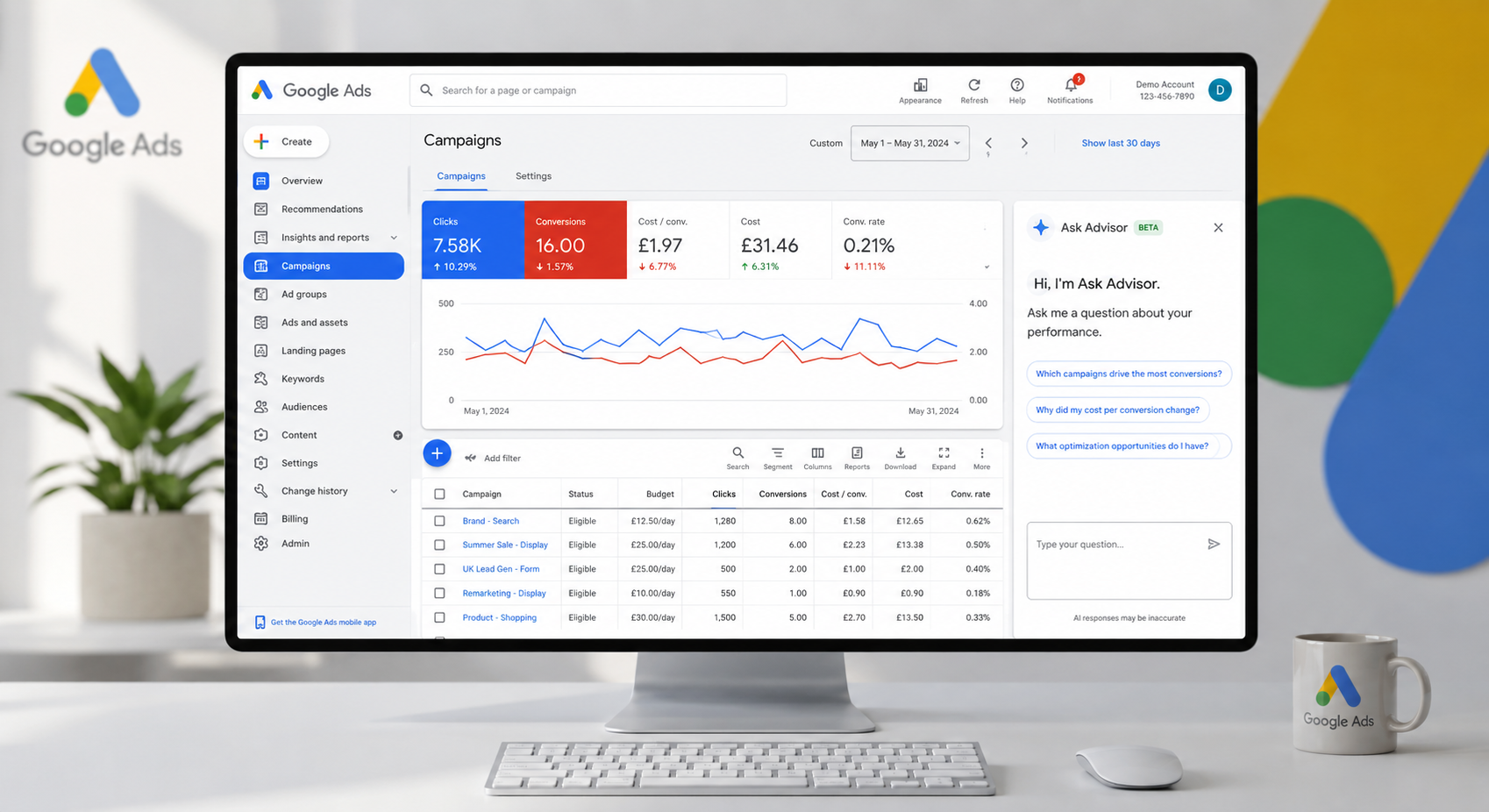
A Google Ads account can now generate headlines, expand keyword themes, shift budget and recommend new audiences before the next weekly marketing meeting. That speed can be useful. But AI advertising only improves commercial performance when it is directed by accurate data, clear profitability targets and experienced human judgement.
For UK businesses, the question is not whether to use AI in paid media. Google, Meta, TikTok and LinkedIn already use machine learning throughout their advertising products. The real question is where to give automation freedom, where to set firm controls, and how to tell whether a reported improvement is producing genuine revenue rather than simply more platform-attributed conversions.
What AI advertising actually means
AI advertising is the use of machine learning and generative AI to make, manage and improve advertising activity. In practice, it covers automated bidding, audience expansion, creative generation, product-feed optimisation, budget recommendations, predictive reporting and campaign diagnostics.
It is not a replacement for marketing strategy. A platform can identify patterns across millions of auction signals far faster than a person can. It cannot independently decide whether your lead quality is acceptable, whether a discounted sale is profitable, or whether a new customer is likely to buy again.
This distinction matters because advertising platforms are designed to help advertisers spend effectively within their ecosystems. Their recommendations may increase conversion volume, but conversion volume is not always the same as profitable growth. A London service business may need qualified enquiries from homeowners within a specific service area. An ecommerce brand may need contribution margin after delivery, returns and discounts. Those requirements need to be built into the account rather than assumed by the algorithm.
Where AI advertising can create genuine value
Used well, AI reduces manual workload and reacts to auction conditions at a scale no account manager could replicate. It is particularly valuable where campaigns have enough reliable conversion data and a clearly defined objective.
Four areas tend to offer the strongest return:
- Smart bidding: Google Ads can adjust bids in real time using signals such as device, location, time, search intent and likelihood to convert. Target CPA and target ROAS strategies can outperform fixed manual bids when conversion tracking is dependable.
- Campaign expansion: Performance Max, Demand Gen and Meta’s automated campaign types can find demand beyond a narrow keyword list or manually selected audience. This can support scale when existing campaigns have reached their ceiling.
- Creative production and testing: Generative tools can help produce variations of ad copy, image concepts and video cut-downs. This is useful for testing angles quickly, particularly for ecommerce promotions and paid social campaigns.
- Analysis and anomaly detection: AI can surface sudden changes in spend, conversion rate, search demand or product performance. It can shorten the time between a problem appearing and someone investigating it.
The word to focus on is “help”. AI can help produce a larger testing programme, but it cannot tell you whether the output reflects your brand properly. It can help find more conversions, but it cannot verify that the sales team will accept those leads. The commercial framework still comes first.
The risks of letting the platform mark its own homework
Automated campaigns often look convincing in platform dashboards. Spend is rising, cost per conversion is falling and the system is reporting more revenue. That can be a positive result, but it deserves scrutiny.
The first risk is poor conversion signals. If every contact-form submission is counted as a lead, automated bidding will pursue more form submissions, including low-intent enquiries, spam and job applications. If an ecommerce account records gross revenue without accounting for cancellations, returns or low-margin products, a target ROAS may encourage sales that weaken net profitability.
The second risk is platform bias. Google and Meta have more visibility over activity inside their own platforms than over calls, offline sales, repeat purchases or assisted conversions elsewhere. Their recommendations naturally favour broader adoption of their campaign types, creative tools and automation settings. That does not make the advice wrong, but it does mean it should be tested against independent business data.
The third risk is reduced visibility. Performance Max and heavily automated social campaigns can limit the detail available on placements, search terms, audience segments and individual creative decisions. For some businesses, that trade-off is worthwhile. For regulated sectors, premium brands or companies with strict geographic and brand-safety requirements, it may not be.
Build measurement before increasing automation
AI works from the signals it receives. If the data is incomplete, delayed or incorrectly valued, the system will optimise towards the wrong outcome with impressive efficiency.
For lead generation, this normally means defining what counts as a meaningful lead and feeding qualified outcomes back into the ad platform where possible. A booked appointment, completed survey, sales-qualified lead or signed contract is often more useful than a basic enquiry. Even where offline conversion imports are not immediately possible, regular analysis of lead quality by source, campaign and keyword can prevent budget drifting towards cheap but unproductive activity.
For ecommerce, the starting point should be clean purchase tracking and accurate product data. From there, businesses should consider which commercial signals matter most: gross margin, stock availability, new versus returning customers, average order value, refund rate and repeat purchase potential. A best-selling product with a thin margin is not always the product worth pushing hardest.
Attribution also needs a realistic view. Different models will report different answers, especially when customers research across search, social, video and remarketing before buying. Rather than chasing a perfect attribution model, use consistent reporting and compare paid-media trends with total revenue, qualified leads, CRM outcomes and profit. The objective is a decision-making system that is useful, not a dashboard that merely looks precise.
A disciplined approach to AI advertising
The strongest accounts treat automation as part of a managed process, not a set-and-forget setting. A practical operating model usually follows five steps.
- Set the business objective. Decide whether the priority is profitable new-customer revenue, qualified leads, booked appointments, online sales or market expansion. Give the platform a target that reflects this goal.
- Audit the data. Check tags, consent configuration, conversion actions, revenue values, product feeds and CRM hand-offs. Remove duplicate or low-value signals before asking an algorithm to learn from them.
- Test with control. Do not move an entire account into an automated campaign type because a platform prompt suggests it. Define a test budget, expected timeframe and comparison point. Consider seasonality, promotions and stock changes before judging the outcome.
- Protect the budget. Use sensible location settings, exclusions, negative keywords where available, brand-safety controls, asset approvals and spend limits. Automation should operate within commercial guardrails.
- Review profit, not just platform metrics. Assess CPA, ROAS and conversion rate alongside lead quality, revenue, margin and sales-team feedback. If performance looks strong in the ad account but weak in the business, investigate before scaling.
This approach may sound less exciting than handing everything to an algorithm. It is also how businesses avoid paying for apparent efficiency that never reaches the bottom line.
Human expertise remains the competitive advantage
AI has changed the mechanics of paid media, but it has not removed the need for skilled campaign management. In many cases, it has made strategic judgement more valuable. Someone still needs to decide how budgets should be divided between branded and non-branded search, prospecting and remarketing, acquisition and retention, or Google and paid social.
Someone also needs to challenge recommendations. If a campaign’s ROAS improves because it is taking credit for existing branded demand, that is not the same as creating incremental sales. If a broad audience expands lead volume while sales quality falls, the correct response may be to tighten the signal, not celebrate the lower CPA.
Maple Forest Marketing combines AI-enabled campaign management with hands-on PPC oversight, focused on the measures that matter to a business: profitable sales, qualified leads, sustainable ROAS and less wasted spend. The technology provides speed and scale; experienced management provides accountability.
The most useful way to approach AI advertising is to ask a simple commercial question before accepting any recommendation: will this make each pound of budget work harder for the business, or merely make the platform report a better number? A free PPC audit can often reveal the difference before more budget is committed.