A Google Ads account can look busy while quietly losing money. Campaigns are live, clicks are coming in and reports show activity, yet lead quality is poor, ecommerce margins are squeezed and nobody can say which spend is genuinely driving profit. That is the real question behind in house versus PPC agency: not who can press the buttons, but who can make better commercial decisions with every pound invested.
For a UK business owner or marketing director, the answer is rarely ideological. An in-house team can bring proximity to the product and sales operation. A specialist PPC agency can bring deeper platform knowledge, wider testing experience and the discipline to challenge assumptions. The best choice depends on the account’s complexity, growth ambitions and the cost of getting decisions wrong.
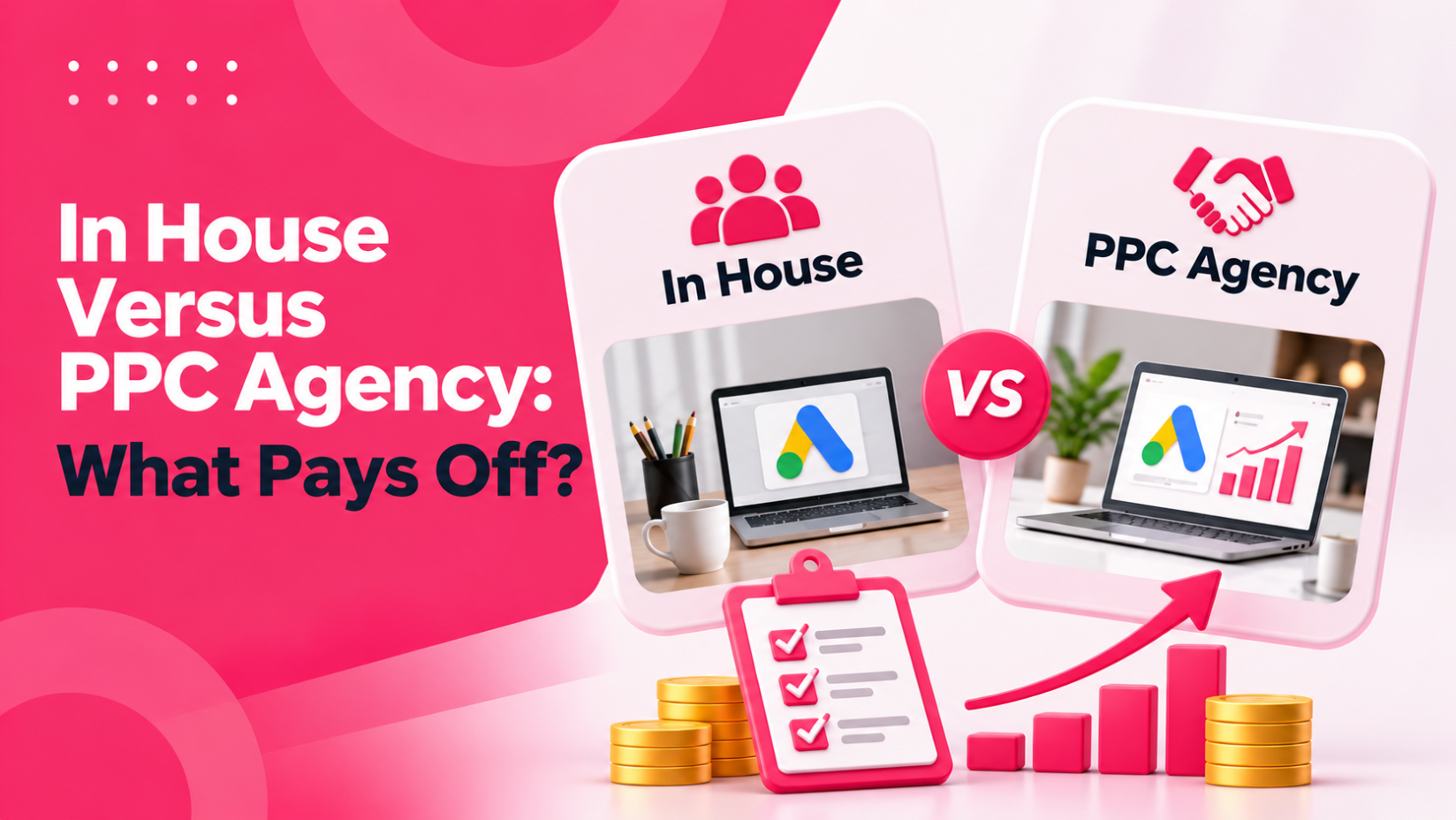
In House Versus PPC Agency: Start With the Commercial Need
Before comparing salary against agency fees, define what paid media needs to achieve. A local service business may need a reliable volume of qualified enquiries at an agreed cost per acquisition. An ecommerce brand may need to protect net margin while scaling Shopping, Performance Max, paid social and remarketing. These are different operational problems.
The right model should be assessed against the outcomes that matter to the business: revenue, qualified leads, CPA, ROAS, conversion rate and, where possible, profitability after product, fulfilment and advertising costs. Click-through rate and impression share can help diagnose performance, but they are not the end goal.
A useful starting point is to ask three direct questions:
- Is paid media a core growth engine that requires daily attention?
- Do we have accurate conversion tracking and enough data to make confident optimisation decisions?
- Does the team have the time and senior expertise to manage strategy as well as campaign administration?
If the answer to the third question is no, keeping management in house can create a false economy. The media budget may be far larger than the management cost, so even small inefficiencies can outweigh any saving.
The Case for an In-House PPC Team
An in-house PPC manager sits close to the business. They can hear recurring objections from the sales team, understand stock constraints, spot changes in pricing and respond quickly when a new product or promotion needs support. That proximity is valuable, particularly where campaigns depend on detailed product knowledge or frequent commercial changes.
In-house management also gives a business direct control over priorities. There is no external briefing process, and the person running the account may be able to work closely with content, CRM, web development and sales. When this is well resourced, paid media becomes part of a joined-up acquisition strategy rather than a separate channel.
The difficulty is that one person is rarely a complete paid media department. Google Ads alone can involve Search, Shopping, Performance Max, Demand Gen, YouTube, audience strategy, feed management, tracking, landing-page testing and reporting. Add Meta, LinkedIn or TikTok, and the specialist workload expands quickly.
An in-house hire also carries costs beyond salary. Employers need to allow for pension contributions, recruitment, training, management time, holiday cover and the risk that knowledge leaves with the individual. A capable generalist may be excellent at planning and stakeholder management but not have the depth required to diagnose why a Performance Max campaign is prioritising low-value conversions or why a product feed is restricting Shopping visibility.
For larger organisations, the strongest in-house model often includes a senior paid media lead supported by channel specialists, analytics resource and creative capacity. That can work extremely well. It is less realistic for many growing businesses that need expert execution but cannot justify several specialist hires.
What a PPC Agency Should Add
A good agency should not simply take tasks off your desk. It should make the advertising investment more accountable.
Experienced PPC specialists see patterns that an isolated account manager may not encounter. They understand how bidding behaviour changes across sectors, where tracking commonly breaks, when automated bidding is working against business goals and how creative, product feeds and landing pages affect conversion quality. They also test hypotheses across multiple accounts, while applying that learning carefully rather than copying a generic template.
This matters because advertising platforms are designed to increase advertising activity. Google and Meta automation can be highly effective, but platform recommendations should be tested against your own margins, lead quality and sales data. More conversions do not automatically mean better customers. A lower CPA is not a win if sales teams spend their week pursuing enquiries that never become revenue.
A specialist agency should therefore bring several practical advantages:
- Senior scrutiny of campaign structure, search terms, audiences, bids and budget allocation.
- Better measurement, including enhanced conversions, call tracking, ecommerce revenue accuracy and CRM feedback where available.
- Cross-channel planning, so Search, Shopping, paid social, video and remarketing support the same growth objective.
- Regular optimisation based on agreed KPIs rather than a once-a-month report full of platform metrics.
There are trade-offs. An agency will never know your customers as instinctively as your internal team does on day one. It needs clear access to commercial information, sales feedback and decision-makers. If an agency is left to work from a vague brief, even technically sound campaigns can target the wrong products, locations or customer types.
The best client-agency relationships operate as a partnership. The business brings market intelligence and commercial direction; the agency brings paid media expertise, analytical discipline and an independent view of where budget is being wasted.
Cost: Look Beyond the Monthly Fee
The most common comparison is straightforward: an employee’s salary versus an agency retainer. It is also incomplete.
An in-house hire may appear cheaper than an agency once the ad budget reaches a certain level. But that calculation should include the full employment cost, software, training, recruitment and the level of seniority required. It should also recognise opportunity cost. If a campaign wastes £3,000 each month through poor tracking, broad targeting or unqualified lead generation, a lower management cost offers little comfort.
Agency pricing deserves scrutiny too. Low fees can mean high account loads, junior management or minimal strategic input. High fees are not proof of quality. Ask what is included: who will manage the account, how often optimisation happens, how reporting connects to revenue and whether there is a clear route to speak with the person making decisions.
A sensible evaluation focuses on incremental value. If specialist management improves conversion rate, reduces wasted spend and reallocates budget towards profitable campaigns, it may pay for itself many times over. If the account is simple, stable and competently run internally, an agency may add less value on an ongoing basis than targeted consultancy or periodic auditing.
When a Hybrid Model Makes Sense
The choice does not have to be all or nothing. A hybrid approach is often the most practical route for businesses that want internal ownership without building a full paid media team.
For example, an in-house marketing manager can own product priorities, promotions, content and sales feedback, while an agency handles account strategy, technical optimisation, campaign builds and reporting. This keeps commercial knowledge close to the business while ensuring that specialist work receives enough attention.
Hybrid arrangements are particularly useful during periods of change: migrating tracking, launching ecommerce internationally, rebuilding a website, scaling spend or introducing Performance Max and paid social alongside established Search activity. They can also help an internal team develop confidence without leaving them to learn expensive lessons on a live budget.
How to Make Either Model Work
Whether management sits in house or with an agency, performance improves when accountability is clear. Set targets that reflect commercial reality, not only platform outputs. Agree what counts as a qualified lead. Feed closed-sale data back into decision-making. Review spend against margin, capacity and seasonality rather than treating every month as identical.
Tracking deserves particular attention. Without reliable conversion data, automated bidding learns from weak signals and reporting becomes difficult to trust. A form completion may be valuable, but it is not equivalent to a confirmed job, a booked consultation or a completed purchase. Where possible, distinguish between them.
Finally, protect time for strategy. Daily checks have their place, but the biggest gains often come from stronger offers, better landing pages, cleaner feeds, sharper audience definitions and a willingness to stop funding activity that cannot prove its value.
For businesses unsure where the leaks are, an independent PPC audit can provide a clear starting point before committing to a recruitment process or a long-term agency agreement. Maple Forest Marketing approaches that review through the numbers that matter: wasted spend, conversion quality, CPA, ROAS and the practical opportunities to generate more profitable growth.