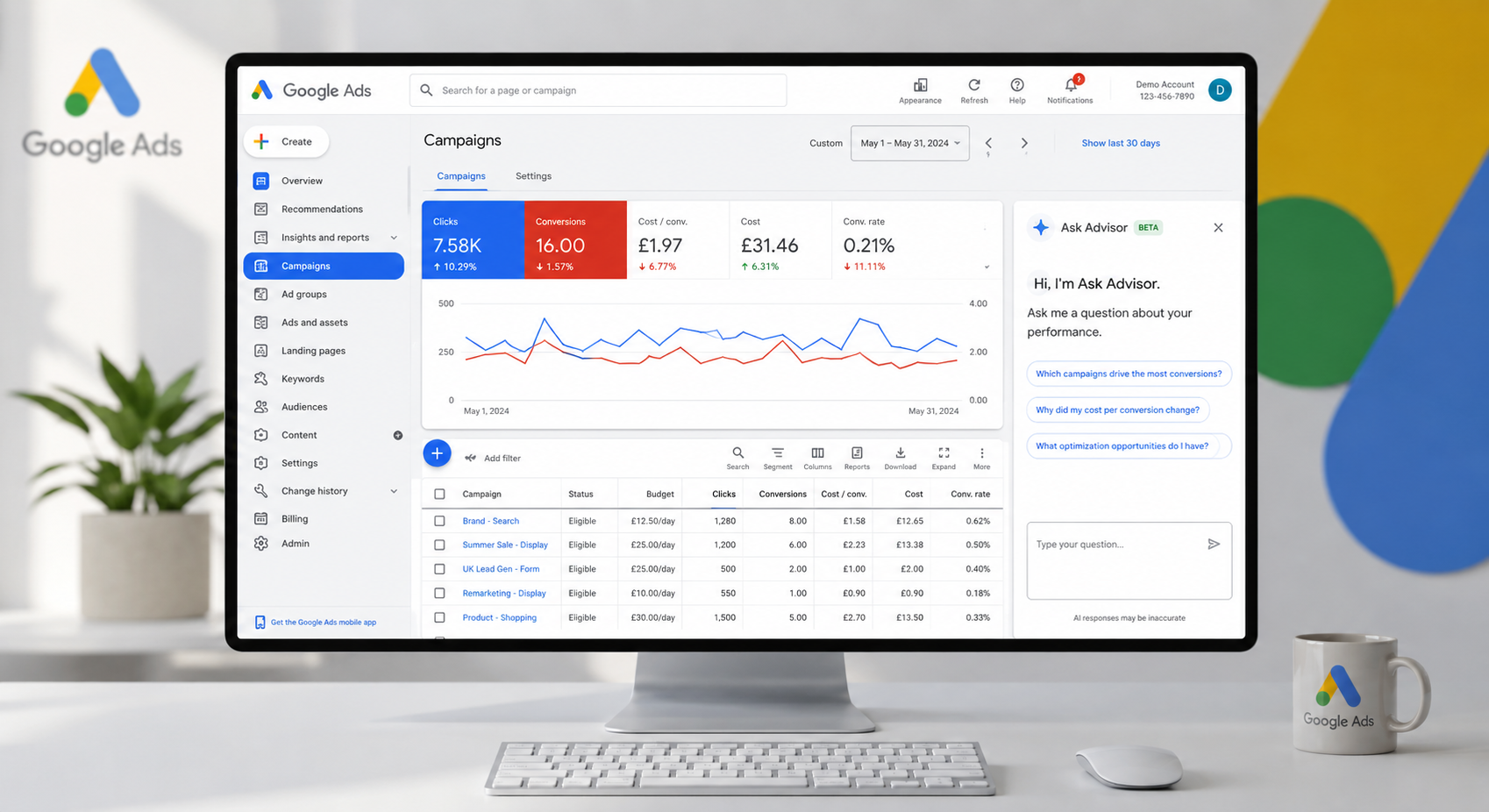
A London service business can spend £2,000 on Facebook Ads and receive plenty of form fills, yet struggle to turn them into appointments. The same budget in Google Ads may generate fewer enquiries but more customers ready to buy. That is the practical difference behind Google Ads versus Facebook Ads: this is not a simple contest between two advertising platforms. It is a decision about buyer intent, sales cycle, margin, creative strength and how reliably you can measure commercial results.
For many businesses, the strongest answer is not one channel or the other. It is knowing what each platform should do in the journey from first impression to profitable sale.
Google Ads versus Facebook Ads: the core difference
Google Ads captures existing demand. A prospective customer searches for a product, service or solution because they have a need now. Whether they type “emergency plumber near me”, “commercial office furniture” or “buy running shoes”, search advertising puts your business in front of someone actively looking.
Facebook Ads, managed through Meta’s advertising platform, is usually better at creating and shaping demand. People are not typically scrolling Facebook or Instagram intending to request a mortgage quote or replace a boiler. They are browsing content. Your advert has to earn attention, make the problem feel relevant and give them a reason to act.
That distinction affects almost every campaign decision:
- Google Ads is generally stronger for high-intent lead generation and product searches.
- Facebook Ads can be highly effective for audience building, demand generation and visual product discovery.
- Google often rewards relevance to a known need, while Facebook rewards creative that interrupts scrolling in the right way.
- Both can drive sales, but their attribution patterns and lead quality can look very different.
The right choice depends on whether your immediate constraint is a lack of demand, weak visibility when demand exists, or poor conversion after the click.
When Google Ads should take priority
Google Ads is usually the first paid channel to test when customers clearly search for what you sell. This is especially true for local services, B2B solutions with urgent requirements, high-consideration purchases and ecommerce products with recognisable demand.
A roofing company, for example, does not need to persuade someone that a leaking roof is inconvenient. It needs to appear when that person searches for a roofer in their area. A carefully structured Search campaign, supported by call tracking, location targeting and negative keywords, can produce enquiries with a clear commercial need.
For ecommerce, Google Shopping and Performance Max can place products across Search, Shopping, YouTube, Display and Gmail inventory. This can scale revenue effectively, but it is not a reason to hand the account to automation without scrutiny. Feed quality, product margins, stock availability, audience signals and conversion tracking all influence whether Performance Max is finding profitable customers or merely spending efficiently against low-value sales.
Google Ads also offers a clearer path to intent-led reporting. Search term data, keyword themes, phone calls, enquiry forms and revenue can be connected to a customer’s stated need. That does not make it effortless. Broad match, automated bidding and campaign recommendations can waste budget when they are not governed by commercial targets. But the intent signal is often strong.
Google Ads is likely to deserve a larger share of budget when you have meaningful search volume, a competitive offer and a website built to convert visitors into calls, enquiries or purchases.
The limits of search demand
Google cannot capture demand that does not yet exist. If potential customers do not know your product, have not recognised the problem, or are not searching with useful volume, Search alone will hit a ceiling.
This is common with new products, specialist B2B services and brands entering a crowded category. In these cases, relying solely on people searching for your exact solution can leave growth on the table. That is where paid social can introduce the offer before the search begins.
When Facebook Ads should take priority
Facebook and Instagram advertising is powerful when the product can be understood quickly, demonstrated visually or positioned around a relatable problem. Ecommerce brands, home and lifestyle products, fitness, beauty, education, events and subscription offers often benefit from Meta’s ability to build familiarity at scale.
The platform’s targeting has changed considerably since privacy restrictions reduced the availability of detailed audience data. A campaign should not depend on narrow interest targeting alone. Strong first-party data, well-configured tracking, broad prospecting, quality creative and a disciplined testing programme now matter far more.
For an ecommerce retailer, a short video showing how a product works can create interest among people who were not searching for it that morning. Dynamic product adverts can then bring back visitors who viewed items or abandoned a basket. This makes Facebook Ads particularly useful across discovery, consideration and remarketing.
For lead generation, the trade-off requires more care. Native lead forms may produce a low cost per lead, but a cheap lead is not automatically a qualified opportunity. If sales teams report poor contact rates, low intent or no-show appointments, campaign optimisation needs to move beyond headline CPL. Use qualification questions, CRM feedback and offline conversion data to assess cost per booked meeting, cost per opportunity and ultimately cost per acquisition.
Facebook Ads should take priority where creative can communicate value quickly, customer demand needs to be developed, or your existing website traffic creates a valuable remarketing audience.
Budget allocation: avoid splitting spend by habit
A common mistake is giving Google and Facebook equal budgets simply because both platforms are available. Equal spend is rarely a strategy. Allocate budget according to the opportunity, the evidence and the point at which each channel contributes.
A local accountancy firm might place most of its budget into Google Search during self-assessment season, then use Facebook selectively for remarketing and educational content. A fashion retailer may invest more heavily in Meta for customer acquisition and creative testing, while using Google Shopping to capture high-intent searches and protect branded demand.
Start with the channel that has the clearest route to profitable action. Once conversion tracking is dependable, expand into the second channel with a specific role rather than vague expectations. For example, Meta may be tasked with generating new qualified visitors and Google with converting returning high-intent users. That gives each campaign a measurable job.
Measure the metrics that protect profit
Platform dashboards are useful, but neither platform should be treated as the final authority on performance. Both have an interest in claiming credit for conversions. Their attribution models can overlap, particularly when a buyer sees a Facebook advert, later searches on Google and converts after several visits.
A commercially sound reporting framework connects advertising data to business outcomes. For ecommerce, this means revenue, gross margin, new versus returning customers, refund rates and true ROAS. For lead generation, it means lead quality, booked appointments, sales-qualified opportunities, close rate and CPA based on actual customers.
Pay close attention to these questions:
- Are we optimising to a meaningful conversion, rather than a page view or basic form completion?
- Does the CRM show that leads from each channel are contacted and qualified at similar rates?
- Can conversion values reflect different product margins, service values or lead quality?
- Is growth incremental, or are campaigns simply claiming sales that would have happened anyway?
This level of measurement is particularly important when using automated bidding, Performance Max or Meta’s Advantage+ campaign options. Automation can improve efficiency at scale, but it works from the signals it receives. If the signal is weak, incomplete or commercially misleading, the platform will optimise towards the wrong outcome very quickly.
The website is part of the media plan
Neither Google Ads nor Facebook Ads can compensate indefinitely for a slow, unclear or unconvincing landing page. Search traffic may leave if the page does not immediately answer the query. Social traffic may need more reassurance because the visitor did not arrive with the same level of intent.
Match the landing page to the advert and the stage of awareness. A Google Search advert for a specific service should lead to clear pricing guidance, proof, location relevance and a direct route to enquire. A Facebook campaign introducing a less familiar offer may need customer stories, product demonstrations, frequently asked questions and stronger reasons to trust the brand.
Conversion rate optimisation is not separate from paid media. Improving the percentage of visitors who become customers lowers your effective acquisition cost without increasing media spend.
Make the decision based on evidence, not platform preference
Google Ads versus Facebook Ads is best viewed as a commercial allocation decision. Google is often the sharper tool for harvesting demand that already exists. Facebook is often the stronger tool for creating demand, building audiences and bringing people back when they are ready to buy.
The businesses that grow efficiently do not chase the cheapest clicks or the most flattering dashboard figures. They set clear CPA and ROAS targets, track what happens after the lead or sale, and adjust budgets as evidence develops. If you need an independent view of where spend is leaking or where growth is being missed, a focused PPC audit should start with that evidence rather than a pre-selected channel.